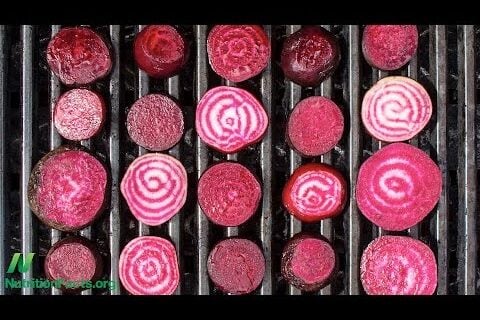
“Our data suggest that betanin, a compound in beet extract, shows promise as an inhibitor of certain chemical reactions in the brain that are involved in the progression of Alzheimer’s disease,” says Li-June Ming, Ph.D.
“This is just a first step, but we hope that our findings will encourage other scientists to look for structures similar to betanin that could be used to synthesize drugs that could make life a bit easier for those who suffer from this disease.”
See how beets dramatically improve blood flow and blood pressure throughout the body in this NutritionFacts.org video, followed by a look at studies on how beets help the brain fight dementia. (The video focuses on dementia 3-minute-28-seconds into the video.) At the end of the article below, see the second “Beets” video, discussing the best amount to eat or drink.
How Beets Beat Alzheimer’s
Amazon Books & Videos
about Alzheimer’s and Dementia:
FREE Newsletter:
Alzheimer’s prime suspect is beta-amyloid, a sticky protein fragment, or peptide. It accumulates in the brain, forming a sticky plaque. It disrupts communication between brain cells called neurons. Much of this damage occurs, Ming says, when beta-amyloid attaches itself to metals such as iron or copper. These metals can cause beta-amyloid peptides to misfold and bind together in clumps that can promote inflammation and oxidation — a process similar to rusting — in nearby neurons, eventually killing them.
Previous research conducted by other scientists suggests that beetroot juice can improve oxygen flow to the aging brain and possibly improve cognitive performance. Building on this work, Ming, Darrell Cole Cerrato and colleagues at the University of South Florida wanted to find out if betanin, a beet compound used in commercial dyes that readily binds to metals, could block the effects of copper on beta-amyloid and, in turn, prevent the misfolding of these peptides and the oxidation of neurons.
In laboratory studies, the researchers conducted a series of experiments involving 3,5 di-tert-butylcatechol, or DTBC, a compound that is used as a model substance for tracking the chemistry of oxidation. Using visible spectrophotometry, the scientists measured the oxidative reaction of DTBC when exposed to beta-amyloid only, beta-amyloid bound to copper, and copper-bound beta-amyloid in a mixture containing betanin.
Beets & Oxidation: Reducing “Rust” in the Brain
On its own, beta-amyloid caused little or no oxidation of DTBC. However, as expected, beta-amyloid bound to copper induced substantial DTBC oxidation. But when betanin was added to the copper-bound beta-amyloid mixture, the researchers found oxidation dropped by as much as 90 percent, suggesting that misfolding of the peptides was potentially suppressed.
“We can’t say that betanin stops the misfolding completely, but we can say that it reduces oxidation,” Cerrato says. “Less oxidation could prevent misfolding to a certain degree, perhaps even to the point that it slows the aggregation of beta-amyloid peptides, which is believed to be the ultimate cause of Alzheimer’s.”
The researchers presented their work at the 255th National Meeting & Exposition of the American Chemical Society (ACS).
How Much Beet Juice Do I Need?
NutritionFacts.org Video: See the optimal timing and dose of nitrate-containing vegetables, such as beets.







Just another reason not to get the flu shot! At least some of the states (if not all) flu shots contain copper. The toxins run down your immune system. This info explains one reason why! Plaque or whatever bind to the toxins and metals.
Clears the lungs out too. One beetroot, one apple and one carrot juiced and drunk on an empty stomach, 30 mins before breakfast. Mom loves the taste too.
For cognition, how much organic pure Beetroot juice, not from concentrate would one have to drink a day and would it be better to drink it in 4oz amounts twice a day Am & pm or at pm since REM sleep is what helps remove toxins from the brain?