Share This Page

Does Dementia Risk Depend on Where You Live?

See one of the largest and most comprehensive studies identifying where dementia occurs most often.
USA map of dementia rates

In one of the largest and most comprehensive studies of its kind, a research team led at UC San Francisco has identified the regions where dementia occurs most often.
What They Discovered

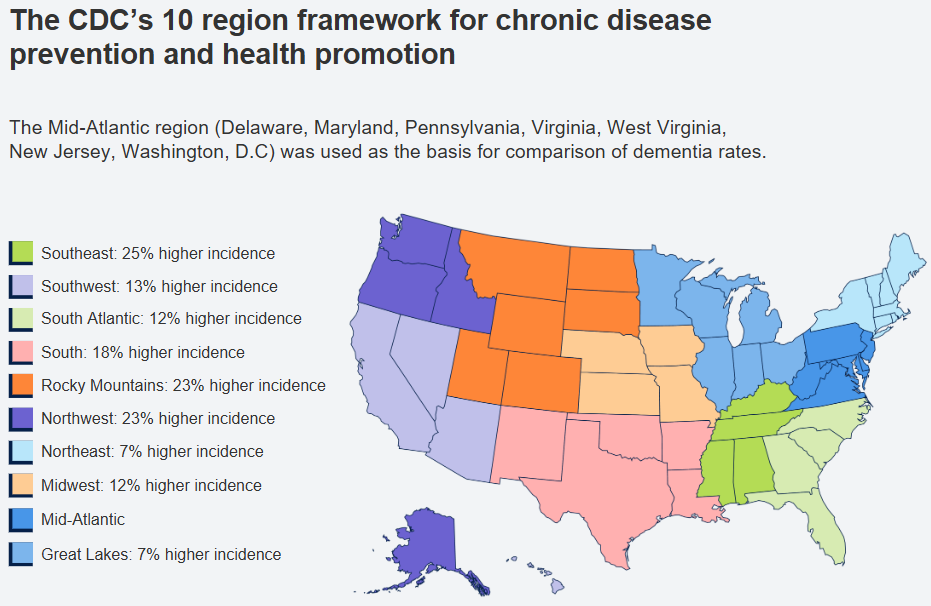
Using the Mid-Atlantic as the basis for comparison, researchers found that dementia rates were 25% higher in the Southeast. The Northwest and Rocky Mountains were both 23% higher, and the South was 18% higher. The Southwest, which includes California, was 13% higher; while the Northeast, which includes New York, was 7% higher.

These differences remained when researchers accounted for factors like age, race, and cardiovascular disease. This includes rural areas, where medical care may be less accessible, compared to urban areas.


What’s Next

“The study underscores the need to understand regional differences in dementia and the importance of region-specific prevention and intervention efforts,” said senior author Kristine Yaffe, MD, also of the San Francisco VA Health Care System.

First author Christina Dintica, PhD, said the next step is to investigate the factors driving these differences. “Quality of education, early life conditions, and environmental exposures may be among those factors.”

Reference:

Funding:

  • Alzheimer’s Association (AARF-21-851960), National Institute on Aging (R35 AG071916), Department of Defense (W81XWH-22-1-096).

Related:

Email me when people comment
Notify of
guest

0 Comments
Inline Feedbacks
View all comments
By:
Picture of Peter Berger

Peter Berger

With experience in dementia caregiving, public education, and Alzheimer’s-focused writing—and a professional research background shaped in what many consider one of the world’s top laboratories—I work to make complex findings clear, practical, and genuinely helpful for families and professionals providing care.

This site was inspired by my Mom’s autoimmune dementia.

It is a place where we separate out the wheat from the chafe, the important articles & videos from each week’s river of news. Google gets a new post on Alzheimer’s or dementia every 7 minutes. That can overwhelm anyone looking for help. This site filters out, focuses on and offers only the best information. it has helped hundreds of thousands of people since it debuted in 2007. Thanks to our many subscribers for your supportive feedback.

The site is dedicated to all those preserving the dignity of the community of people living with dementia.

Peter Berger, Editor

Share this page To

Dementia Books & Videos on Amazon:

More From Alzheimer's Weekly

Diagnosis

Poor Memory + Slow Walking = Dementia?

People may not have easy access to sophisticated, expensive dementia tests. A simple test from Einstein Medicine uses a stopwatch and a few questions to determine one’s risk of dementia. The potential payoff could be tremendous for individuals, their families and society.

Read More »
Share to Facebook
Twitter
LinkedIn

Visit Alzheimer's Weekly On

Welcome

Alzheimer’s & Dementia Weekly was inspired by my mother’s journey with autoimmune dementia and my dad’s with Parkinson’s dementia.

Walking beside them opened my eyes to the confusion, the courage, and the deep humanity found in families and professionals caring for someone they love.

Since its debut in 2007, this site has had one clear mission:
to separate the wheat from the chaff — to highlight only the most essential articles, studies, tools, and videos from the overwhelming river of dementia-related information.
(At last count, Google receives a new post on Alzheimer’s or dementia every seven minutes.) For anyone seeking clarity or support, that constant flow can be exhausting and discouraging.

Alzheimer’s Weekly filters, translates, and explains what matters most, helping hundreds of thousands of families, clinicians, and care teams around the world make sense of the latest research and best practices.

This site is dedicated to everyone who works—often quietly and tirelessly—to preserve dignity in the community of people living with dementia.


About the Editor

With experience in dementia caregiving, public education, and Alzheimer’s-focused writing—and a professional research background shaped in what many consider one of the world’s top laboratories—I work to make complex findings clear, practical, and genuinely helpful for both families and professionals providing care.

My goal is simple:
Translate the best science into guidance that lightens the load, strengthens understanding, and helps every person with dementia live with dignity.

Peter Berger
Editor, Alzheimer’s Weekly

Free:
Alzheimer's & Dementia
Weekly Newsletter

INCLUDES BONUS BOOKLET:
15 Simple Things You Can Do to Care For a Loved One with Dementia or Memory Loss
News, Treatments, Care Tips, Diet, Research, Diagnosis, Therapies & Prevention
News to Get at the Truth

Subscribe To Our Weekly Newsletter

0
Would love your thoughts, please comment.x
()
x