Share This Page

Leqembi Prescriptions Could Rise Sharply. Why?

Alzheimer’s treatment eligibility may be far larger than previously thought. A major Nature study using blood tests suggests millions more older adults could qualify for treatment than current use reflects. As diagnosis becomes easier, demand for drugs like Leqembi could shift sharply.
"Alzheimer's Treatment Demand" chart behind patient, caregiver and doctor.

If you’ve been following Leqembi for Alzheimer’s (Leqembi is the brand name for generic lecanemab), you’ve probably noticed a gap between the headlines (“first disease-modifying therapy”) and real life (few people actually getting prescriptions.).

A major new Nature paper helps explain why that gap may not last. It suggests that when doctors are given clear eligibility criteria, structured imaging pathways, and manageable safety protocols, many more patients qualify than previously assumed. The result is not merely higher interest in Leqembi, but a realistic scenario in which prescriptions, not just discussions, could rise sharply. (Article continues below video…)


Why this matters
If Alzheimer’s diagnosis becomes simpler, millions more people could suddenly qualify for treatment — reshaping access, planning, and demand far faster than today’s numbers suggest.

Researchers tested 11,486 community-dwelling adults in Norway using a highly accurate blood biomarker for Alzheimer’s pathology (plasma p-tau217)—a practical stand-in for the amyloid/tau changes that define Alzheimer’s disease neuropathological changes (ADNC). In other words, they measured the biology of Alzheimer’s at population scale, not just in memory clinics.

Their results imply that the “treatable” pool is far larger than current systems are built to handle—and that demand for drugs like Leqembi could rise sharply as blood tests become routine and eligibility is clarified.

What the study found (the numbers that change the story)

In participants 70 and older, the researchers estimated:

  • 10% had preclinical Alzheimer’s (biological changes, but cognitively unimpaired)
  • 10.4% had prodromal Alzheimer’s (often aligning with MCI)
  • 9.8% had Alzheimer’s dementia
  • Overall, ADNC positivity rose steeply with age—reaching 65.2% in those over 90.
  • In the 70+ group overall, about 33.4% were ADNC-positive by their p-tau217 “rule-in” cut-off.

Most importantly for Leqembi planning: using contemporary treatment-eligibility logic (an algorithm based on current monoclonal antibody recommendations), 909 out of 8,949 people aged 70+—about 10.1%—met eligibility criteria for disease-modifying therapy.

That single number is the “demand multiplier.” It suggests a future where roughly one in ten older adults could be candidates—if the diagnostic pipeline is fast, standardized, and accessible.

The gap between today’s Leqembi use and biological eligibility may be far larger than most people realize.
Leqembi Today vs. Where Demand Could Go
A large community study in Nature used a blood biomarker to estimate how common Alzheimer’s disease pathology is in older adults. The headline implication: the “treatable pool” may be far larger than today’s treatment numbers suggest.
NATURE (COMMUNITY BLOOD TEST DATA)
~10.1%
of adults 70+ met an algorithm consistent with current disease-modifying therapy (DMT) eligibility logic.
Additional context from the same paper (age 70+):
  • Preclinical AD: 10.0%
  • Prodromal AD: 10.4%
  • AD dementia: 9.8%
  • AD pathology present in: 60% of dementia, 32.6% of MCI, 23.5% cognitively unimpaired
U.S. “ELIGIBLE POOL” BENCHMARK
~1.4M
Estimated number of U.S. patients eligible for amyloid-targeting treatment in the early Alzheimer’s window (often cited in policy and budget-impact discussions).
Why caregivers should care: if blood tests become routine, more people will be identified earlier—before they reach later-stage dementia.
REAL-WORLD UPTAKE (U.S.)
~13,500
People reported to be on Leqembi in the U.S. (as of early 2025).
What share is that?
Using the ~1.4M “eligible” benchmark, that’s roughly:
Estimated treated share (early 2025)~1%
 
CMS actuarial projections reported by major health outlets implied a steep rise in treated patients (on the order of tens of thousands in 2024 and potentially ~100k+ in 2025), if infrastructure and coverage keep expanding.
Illustrative “treated share” if ~130k treated in 2025~9%
 
Caregiver takeaway: This does not mean every eligible person will take Leqembi. But it does mean today’s treatment numbers may reflect diagnostic and access bottlenecks more than true need. As blood tests spread, more families may reach the “Are we eligible?” conversation earlier—potentially increasing demand for infusions, MRIs, specialists, and treatment decisions.
Notes: “~1%” and “~9%” are approximate ratios using published benchmarks (treated / estimated eligible). Real-world uptake will vary by access, safety screening, physician capacity, and patient preferences.

Where Leqembi is today: the uptake reality

It’s amazing to imagine that one in ten older adults could realistically be Leqembi candidates in the future. Now compare that to current use.

As of a company-cited update reported in early 2025, there were around 13,500 patients on Leqembi, with about 3,000 prescribers and 1,200 purchasing institutions in the U.S.

Even allowing for growth since then, this is still tiny relative to the likely eligible population.

The “now vs. where it could go” math (U.S. perspective)

A widely cited U.S. health-technology assessment (ICER) estimated about 1.4 million people in the U.S. could be eligible for anti-amyloid treatment in the early Alzheimer’s window.

Using the 13,500 treated figure as a concrete anchor:

  • Estimated treated today: ~13,500
  • Estimated eligible pool: ~1,400,000
  • Share of eligible currently treated: ~0.96% (13,500 ÷ 1,400,000)

In other words: well under 1% of an estimated eligible pool—suggesting a 100x+ runway if infrastructure, referrals, and testing normalize.

The Nature study’s “~10% of 70+ eligible” result is directionally consistent with that kind of scale—especially once blood testing reduces friction and more people are diagnosed earlier.

Why this is caregiver-newsworthy (even if your family never uses Leqembi)

This study isn’t a “Leqembi works” paper. It’s a capacity and demand paper—and that matters to caregivers because it impacts:

Elder with nurse in hospital
  • Wait times for neurology and memory clinics
  • Access to confirmatory testing (PET scans, lumbar puncture, and now blood tests)
  • Infusion capacity and MRI scheduling (ARIA monitoring)
  • Insurance and payer rules as budgets collide with real-world prevalence

If health systems plan based on “tens of thousands,” but the biology suggests “hundreds of thousands to millions,” families may face longer queues—unless systems scale up proactively.

Practical takeaway for caregivers: what to do now

If your loved one has mild symptoms (or MCI) and you want to keep options open:

  1. Ask for a structured cognitive workup (not just “watchful waiting”).
  2. Discuss biomarker confirmation pathways (blood → PET/CSF, depending on location and coverage).
  3. Ask how MRI monitoring is handled if an antibody therapy becomes a consideration.
  4. Plan early for logistics: infusion site, transportation, caregiver availability, and follow-up MRIs.

Even if you decide “not for us,” the process of clarifying diagnosis earlier can improve planning, safety, and access to supportive resources.

The bottom line

This Nature paper is newsworthy because it suggests the Alzheimer’s “treatable pipeline” could be much larger than today’s treatment numbers imply—especially as scalable blood tests move from research into routine care.

If that happens, the limiting factor won’t be interest. It will be system capacity.

And that means: demand for Leqembi (and similar therapies) could look very different in the next few years than it does today.

How quickly Leqembi moves from approval to real-world use may shape Alzheimer’s care more than any single new therapy.

Leqembi Library

Leqembi Likes Asia's Genes. Why?

Leqembi Likes Asia's Genes. Why?

New evidence suggests genetics—not geography—may explain why Leqembi causes fewer ARIA brain side effects in parts of Asia, and what…
Leqembi: Slowing Alzheimer’s — What You Need to Know
Leqembi: Slowing Alzheimer’s — What You Need to Know

Leqembi is one of the first Alzheimer’s treatments proven to slow decline. A new MRI study helps explain what it…
New At-Home Leqembi: What It Means for Alzheimer's

New At-Home Leqembi: What It Means for Alzheimer's

IMAGINE THIS: Instead of going to an infusion center for treatment, you can switch to a weekly injection at home.…
3-Minute 'Fastball' Alzheimer’s Test Could Speed Access to Leqembi

3-Minute 'Fastball' Alzheimer’s Test Could Speed Access to Leqembi

Access to Leqembi, the new Alzheimer’s drug, has been slowed by lengthy diagnoses. The “Fastball” brainwave test could change that…
Leqembi and Kisunla: Inside the Infusion Experience

Leqembi and Kisunla: Inside the Infusion Experience

They’re not just pills—they’re precision infusions designed to slow Alzheimer’s at its source. See UCLA’s cutting-edge Amyloid Immunotherapy Care Program,…
"Is Leqembi Worth It?" Costs and the Road to Wider Access

"Is Leqembi Worth It?" Costs and the Road to Wider Access

Leqembi, the first Alzheimer's-modifying drug, is a giant step forward—but how many people are getting it, and what does it…
How Many Leqembi Patients Are There?

How Many Leqembi Patients Are There?

Alzheimer's rates are on the rise. How is today's best treatment, Leqembi (generic lecanemab) doing in the fight against it?
Leqembi Best at Fighting Alzheimer's in Men
Leqembi Best at Fighting Alzheimer's in Men

See why Leqembi is even more effective in males than females, at fighting Alzheimer's.
Leqembi Becomes Europe's First Alzheimer's Antibody

Leqembi Becomes Europe's First Alzheimer's Antibody

The European Union authorizes Leqembi as its very first Alzheimer's drug to target an underlying cause of Alzheimer's.
Leqembi & Kisunla: Extending Independent Living

Leqembi & Kisunla: Extending Independent Living

A new analysis of the benefits of these Alzheimer's treatments scores the days and ways patients succeed in living independently.
Leqembi: Europe Checks It's Safety; U.S. Approves Monthly Doses

Leqembi: Europe Checks It's Safety; U.S. Approves Monthly Doses

The EMA has announced its schedule for reviewing the Alzheimer's drug Leqembi (lecanemab) for use in Europe. Meanwhile, the U.S.…
Is Leqembi Shrinking the Alzheimer's or the Brain?

Is Leqembi Shrinking the Alzheimer's or the Brain?

Leqembi and Kisunla are the new Alzheimer's immunotherapies. A loss of brain volume associated with these immunotherapies may be caused…
Catching Up to America: Europe Recommends Leqembi® for Alzheimer's

Catching Up to America: Europe Recommends Leqembi® for Alzheimer's

The European Medicines Agency (EMA) recommended approving Leqembi® (generic lecanemab) for Alzheimer's. Originally skeptics, learn how the "Clarity AD" trial…
Leqembi Autoinjector to Treat Alzheimer's in Seconds, Not Hours

Leqembi Autoinjector to Treat Alzheimer's in Seconds, Not Hours

Leqembi is an FDA-Approved Alzheimer's treatment. Hospital infusions take an hour each. 2025 is looking to see a new 15-second…
3 Questions on Leqembi & Kisunla, the New Alzheimer's Drugs

3 Questions on Leqembi & Kisunla, the New Alzheimer's Drugs

The 2 newest Alzheimer's drugs, Leqembi (lecanemab) and Kisunla (donanemab) show promise, but many questions remain. Here are the three…
Leqembi: Pioneering Alzheimer’s Drug Faces Challenge in Europe

Leqembi: Pioneering Alzheimer’s Drug Faces Challenge in Europe

While the initial headlines might seem discouraging, there’s always more to the story. 🌟
How to Choose Between Kisunla vs. Leqembi, The New Alzheimer's Drugs

How to Choose Between Kisunla vs. Leqembi, The New Alzheimer's Drugs

The newest Alzheimer's drugs, Kisunla and Leqembi, are the first to actually slow down Alzheimer's. How do they compare to…
Leqembi Launched in China to Fight Alzheimer's

Leqembi Launched in China to Fight Alzheimer's

China is the third country to launch LEQEMBI for sale, to fight Alzheimer's, following the United States and Japan.
Making it Easier to Take Leqembi for Alzheimer's

Making it Easier to Take Leqembi for Alzheimer's

A drug for Alzheimer’s, called Leqembi, might soon be given less often. Right now, patients get it through a drip…
What Treats Alzheimer's Better? Leqembi or a Plant Based Diet?

What Treats Alzheimer's Better? Leqembi or a Plant Based Diet?

Dr. Dean Ornish publishes the first trial investigating plant-based diets fighting or reversing early-stage Alzheimer's. The results are eye-opening.
LEQEMBI® for Alzheimer’s Now in USA, China, Japan, South Korea

LEQEMBI® for Alzheimer’s Now in USA, China, Japan, South Korea

South Korea joined other countries in approving LEQEMBI® (generic lecanemab) for mild cognitive impairment, mild and early Alzheimer's. Learn how…
Leqembi Injection, an Easier Alzheimer's Treatment, Awaits FDA Approval

Leqembi Injection, an Easier Alzheimer's Treatment, Awaits FDA Approval

LEQEMBI® is the newest Alzheimer's drug. It is administered in hospitals via IV. Biogen applied to the FDA for approval…
Carolyn Davis Talks About Her Leqembi Infusions
Carolyn Davis Talks About Her Leqembi Infusions

The newest and most promising drug to fight Alzheimer's is Leqembi. Carolyn Davis is giving it a try. Learn about…
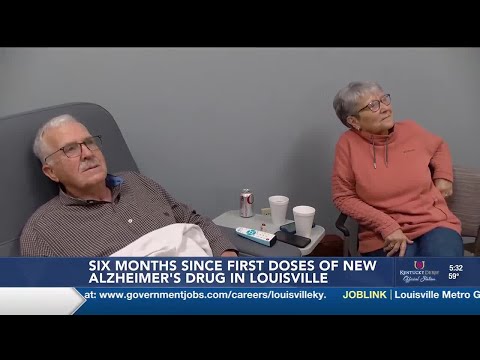
Leqembi for Alzheimer's: Patient and Doctor Hopeful After First 6 Months

Leqembi for Alzheimer's: Patient and Doctor Hopeful After First 6 Months

The first doses of the newly approved Alzheimer's drug "Leqembi" were administered in Louisville. More than 100 people have signed…
Aduhelm for Alzheimer's Discontinued. Is Leqembi Any Better?

Aduhelm for Alzheimer's Discontinued. Is Leqembi Any Better?

Biogen reprioritize resources allocated to ADUHELM® to advance LEQEMBI®.
Leqembi: An Alzheimer's Drug Worth Rooting For?

Leqembi: An Alzheimer's Drug Worth Rooting For?

At long last, we finally have a disease-modifying drug for Alzheimer’s. The FDA recently approved a new drug that promises…
Alzheimer's Drug Leqembi Gets Full FDA and MEDICARE Approval

Alzheimer's Drug Leqembi Gets Full FDA and MEDICARE Approval

First drug to modestly slow Alzheimer's cognitive decline, based on 1,800 patients.
FDA Unanimously Votes Leqembi Benefits Alzheimer's

FDA Unanimously Votes Leqembi Benefits Alzheimer's

The FDA Advisory Committee's endorsement of Leqembi paves way for traditional approval, ushers in a new era for Alzheimer's
Lecanemab Can Delay Alzheimer’s 8 Years: New Data, New Hope

Lecanemab Can Delay Alzheimer’s 8 Years: New Data, New Hope

New long-term data suggests lecanemab could delay the shift from mild memory loss to moderate Alzheimer’s by up to eight…
Arginine on the Frontline: New Hope for Alzheimer’s

Arginine on the Frontline: New Hope for Alzheimer’s

A new study suggests a simple nutrient — arginine — may reduce amyloid-β buildup in Alzheimer’s. The findings, from animal…

Related:

Email me when people comment
Notify of
guest

0 Comments
Inline Feedbacks
View all comments
By:
Picture of Peter Berger

Peter Berger

With experience in dementia caregiving, public education, and Alzheimer’s-focused writing—and a professional research background shaped in what many consider one of the world’s top laboratories—I work to make complex findings clear, practical, and genuinely helpful for families and professionals providing care.

This site was inspired by my Mom’s autoimmune dementia.

It is a place where we separate out the wheat from the chafe, the important articles & videos from each week’s river of news. Google gets a new post on Alzheimer’s or dementia every 7 minutes. That can overwhelm anyone looking for help. This site filters out, focuses on and offers only the best information. it has helped hundreds of thousands of people since it debuted in 2007. Thanks to our many subscribers for your supportive feedback.

The site is dedicated to all those preserving the dignity of the community of people living with dementia.

Peter Berger, Editor

Share this page To

Dementia Books & Videos on Amazon:

More From Alzheimer's Weekly

People celebrating 25 years of Brookdale Senior Living
Care-Facilities

Brookdale Senior Living Marks 25 Years

Brookdale Senior Living of Russellville marked a significant milestone as they celebrated 25 years at their facility. Community members, local businesses and residents came together to commemorate the occasion.

Read More »
Share to Facebook
Twitter
LinkedIn

Visit Alzheimer's Weekly On

Welcome

Alzheimer’s & Dementia Weekly was inspired by my mother’s journey with autoimmune dementia and my dad’s with Parkinson’s dementia.

Walking beside them opened my eyes to the confusion, the courage, and the deep humanity found in families and professionals caring for someone they love.

Since its debut in 2007, this site has had one clear mission:
to separate the wheat from the chaff — to highlight only the most essential articles, studies, tools, and videos from the overwhelming river of dementia-related information.
(At last count, Google receives a new post on Alzheimer’s or dementia every seven minutes.) For anyone seeking clarity or support, that constant flow can be exhausting and discouraging.

Alzheimer’s Weekly filters, translates, and explains what matters most, helping hundreds of thousands of families, clinicians, and care teams around the world make sense of the latest research and best practices.

This site is dedicated to everyone who works—often quietly and tirelessly—to preserve dignity in the community of people living with dementia.


About the Editor

With experience in dementia caregiving, public education, and Alzheimer’s-focused writing—and a professional research background shaped in what many consider one of the world’s top laboratories—I work to make complex findings clear, practical, and genuinely helpful for both families and professionals providing care.

My goal is simple:
Translate the best science into guidance that lightens the load, strengthens understanding, and helps every person with dementia live with dignity.

Peter Berger
Editor, Alzheimer’s Weekly

Free:
Alzheimer's & Dementia
Weekly Newsletter

INCLUDES BONUS BOOKLET:
15 Simple Things You Can Do to Care For a Loved One with Dementia or Memory Loss
News, Treatments, Care Tips, Diet, Research, Diagnosis, Therapies & Prevention
News to Get at the Truth

Subscribe To Our Weekly Newsletter

0
Would love your thoughts, please comment.x
()
x