Share This Page

Sleep Treatments Push Off Memory Loss by 10 Years

VIDEO + ARTICLE:

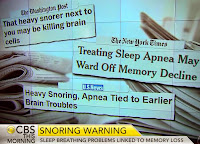
A new study linked heavy snoring or sleep apnea to early memory loss and Alzheimer’s. However, people treating sleep breathing problems with a continuous positive airway pressure (CPAP) machine pushed off memory loss by 10 years, to age 82 on average, instead of 72. See what a good night’s sleep can do for your brain.


Heavy snoring and sleep apnea may be linked to memory and thinking decline at an earlier age, according to a new study published in the online issue of Neurology®, the medical journal of the American Academy of Neurology. The research also suggests that treating the disorders with a breathing machine may delay the decline.

Continued below video…

“Abnormal breathing patterns during sleep such as heavy snoring and sleep apnea are common in the elderly, affecting about 52 percent of men and 26 percent of women,” said study author Ricardo Osorio, MD, with the NYU Langone Medical Center in New York.

For the study, the medical histories for 2,470 people ages 55 to 90 were reviewed. Participants were categorized as either free of memory and thinking problems, in early stages of mild cognitive impairment (MCI), or with Alzheimer’s disease.

The researchers also looked at people with untreated sleep breathing problems versus those without the sleep breathing problems and also untreated versus treated people with sleep breathing problems.

The study found that people with sleep breathing problems were diagnosed with MCI an average of nearly 10 years earlier than people who did not have sleep breathing problems. For example, when researchers examined only people who developed MCI or Alzheimer’s disease during the study, those with sleep breathing problems developed MCI at an average age of 77, compared to an average age of 90 for those who did not have sleep breathing problems. Among that group, those who had sleep breathing problems also developed Alzheimer’s disease five years earlier than those who did not have sleep breathing problems, at an average age of 83 versus 88.

The researchers found that people who treated their sleep breathing problems with a continuous positive airway pressure (CPAP) machine were diagnosed with MCI about 10 years later than people whose problems were not treated, or at age 82 instead of age 72.

“The age of onset of MCI for people whose breathing problems were treated was almost identical to that of people who did not have any breathing problems at all,” Osorio said. “Given that so many older adults have sleep breathing problems, these results are exciting — we need to examine whether using CPAP could possibly help prevent or delay memory and thinking problems.”

Osorio noted that more research is needed. “These findings were made in an observational study and as such, do not indicate a cause-and-effect relationship,” said Osorio. “However, we are now focusing our research on CPAP treatment and memory and thinking decline over decades, as well as looking specifically at markers of brain cell death and deterioration.”


Sources:


Reference:

  1. Ricardo S. Osorio, Tyler Gumb, Elizabeth Pirraglia, Andrew W. Varga, Shou-En Lu, Jason Lim, Margaret E. Wohlleber, Emma L. Ducca, Viachaslau Koushyk, Lidia Glodzik, Lisa Mosconi, Indu Ayappa, David M. Rapoport, Mony J. De Leon. Sleep-disordered breathing advances cognitive decline in the elderlyNeurology, April 2015 DOI: 10.1212/WNL.0000000000001566

Related:

Email me when people comment
Notify of
guest

0 Comments
Inline Feedbacks
View all comments
By:
Picture of Peter Berger

Peter Berger

With experience in dementia caregiving, public education, and Alzheimer’s-focused writing—and a professional research background shaped in what many consider one of the world’s top laboratories—I work to make complex findings clear, practical, and genuinely helpful for families and professionals providing care.

This site was inspired by my Mom’s autoimmune dementia.

It is a place where we separate out the wheat from the chafe, the important articles & videos from each week’s river of news. Google gets a new post on Alzheimer’s or dementia every 7 minutes. That can overwhelm anyone looking for help. This site filters out, focuses on and offers only the best information. it has helped hundreds of thousands of people since it debuted in 2007. Thanks to our many subscribers for your supportive feedback.

The site is dedicated to all those preserving the dignity of the community of people living with dementia.

Peter Berger, Editor

Share this page To

Dementia Books & Videos on Amazon:

More From Alzheimer's Weekly

kitchen, food, cooking, women, meal, job, indoors, service, homecare, homecare, homecare, homecare, homecare, homecare
At Home

Home Help for Dementia: Timing It, Managing It

Knowing when to bring in help — and how to manage it well — can make all the difference in caring for a loved one with dementia. The right timing protects safety and dignity, while good management preserves peace of mind for everyone involved.

Read More »
Share to Facebook
Twitter
LinkedIn

Visit Alzheimer's Weekly On

Welcome

Alzheimer’s & Dementia Weekly was inspired by my mother’s journey with autoimmune dementia and my dad’s with Parkinson’s dementia.

Walking beside them opened my eyes to the confusion, the courage, and the deep humanity found in families and professionals caring for someone they love.

Since its debut in 2007, this site has had one clear mission:
to separate the wheat from the chaff — to highlight only the most essential articles, studies, tools, and videos from the overwhelming river of dementia-related information.
(At last count, Google receives a new post on Alzheimer’s or dementia every seven minutes.) For anyone seeking clarity or support, that constant flow can be exhausting and discouraging.

Alzheimer’s Weekly filters, translates, and explains what matters most, helping hundreds of thousands of families, clinicians, and care teams around the world make sense of the latest research and best practices.

This site is dedicated to everyone who works—often quietly and tirelessly—to preserve dignity in the community of people living with dementia.


About the Editor

With experience in dementia caregiving, public education, and Alzheimer’s-focused writing—and a professional research background shaped in what many consider one of the world’s top laboratories—I work to make complex findings clear, practical, and genuinely helpful for both families and professionals providing care.

My goal is simple:
Translate the best science into guidance that lightens the load, strengthens understanding, and helps every person with dementia live with dignity.

Peter Berger
Editor, Alzheimer’s Weekly

Free:
Alzheimer's & Dementia
Weekly Newsletter

INCLUDES BONUS BOOKLET:
15 Simple Things You Can Do to Care For a Loved One with Dementia or Memory Loss
News, Treatments, Care Tips, Diet, Research, Diagnosis, Therapies & Prevention
News to Get at the Truth

Subscribe To Our Weekly Newsletter

0
Would love your thoughts, please comment.x
()
x