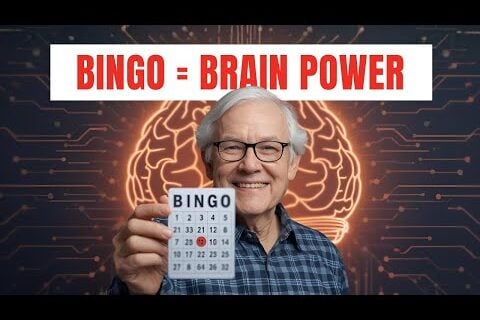
Why bingo keeps appearing in dementia care settings
Bingo has been used in senior centers and memory care programs for decades, largely because it is familiar and easy to run. What research has begun to clarify is why bingo often works better than many other activities for people living with dementia.
Unlike passive pastimes, bingo requires real-time participation. Players must listen, scan, recognize, decide, and respond—often while interacting with others. That combination places bingo squarely in the category of cognitive stimulation, an approach repeatedly linked to better engagement and quality of life in dementia care.
What the research actually measured
Bingo appears in the scientific literature most often as part of structured activity or cognitive stimulation programs in adult day centers and residential care settings. While study sizes are modest, results are consistent.
Key findings include:
Recommended Books on
Communication for Dementia Caregivers:
1. Learning to Speak Alzheimer’s
2. Connecting the Dots
3. Talking to Alzheimer’s
4. You Say Goodbye and We Say Hello
5. Creating Moments of Joy
- Participants engaging in bingo-style cognitive activities performed better on short-term attention and naming tasks than those assigned to physical or passive activities.
- In one controlled study, cognitive engagement activities such as bingo outperformed physical activity alone on immediate cognitive measures (sample size under 50 participants).
- Group-based cognitive stimulation programs, which frequently include games like bingo, are associated with improvements in communication and social interaction, even when long-term cognition does not change.
These effects are short-term, but they are meaningful in daily care.
What bingo activates in the dementia brain
Bingo works because it quietly engages multiple cognitive systems at once.
- Attention and focus
Players must stay alert over several minutes, listening for cues. - Auditory processing
Numbers or words are heard, interpreted, and matched. - Visual scanning
Cards require continuous left-to-right and top-to-bottom scanning. - Recognition and memory
Familiar symbols or numbers are identified and recalled. - Decision-making and response
Players decide when to mark a card or call out. - Social interaction
Shared anticipation, encouragement, and celebration reinforce engagement.
Few single activities combine all of these elements so naturally.
The role of social engagement
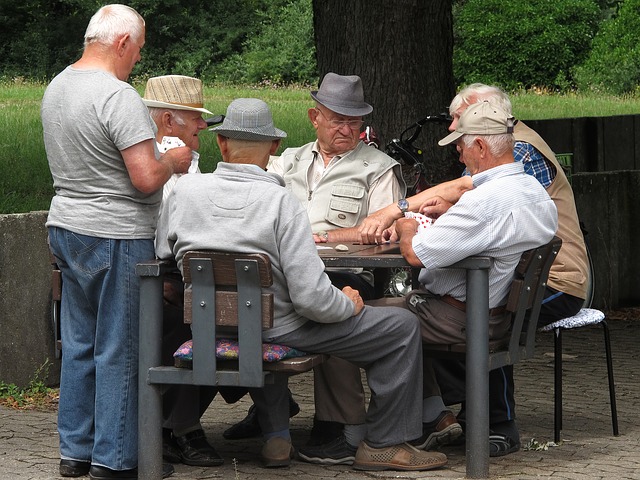
Social engagement is not incidental to bingo—it is central to its value. Longitudinal studies following older adults for years show that people who remain socially active develop dementia later than those who are socially isolated. In one large prospective cohort, higher social activity was associated with a significantly lower risk of dementia over time.
Bingo naturally fosters:
- Eye contact and shared attention
- Conversation and emotional expression
- A sense of belonging and routine
For people with dementia, these social effects often matter as much as cognitive ones.
What bingo can help with
Research and care experience suggest bingo may support:
- Increased alertness during activities
- Better moment-to-moment attention
- Greater verbal participation
- Improved mood and enjoyment
- Reduced apathy during structured sessions
These outcomes align with the goals of supportive dementia care.
What bingo cannot do
It is equally important to be precise.
Bingo does not:
- Slow the biological progression of Alzheimer’s disease
- Prevent dementia on its own
- Replace medication or clinical therapy
Its benefits are functional and emotional, not disease-modifying.
Which stages benefit most
- Mild to moderate dementia
Individuals often follow simplified rules and benefit from the cognitive challenge. - Moderate to advanced dementia
Benefits shift toward emotional engagement—smiling, responding, vocalizing, and feeling included.
Across stages, success should be measured by participation and enjoyment rather than accuracy or winning.
Practical caregiver guidance
To maximize benefit, caregivers and activity leaders should:
- Use large-print, high-contrast bingo cards
- Keep sessions short (15–30 minutes)
- Slow the pace of calling
- Emphasize participation over correctness
- Celebrate engagement, not competition
Many programs report better outcomes when bingo is offered on a predictable schedule, creating anticipation and routine.
Why this matters for caregivers
Dementia care is not only about slowing decline. It is about preserving moments of attention, dignity, and connection. Bingo remains one of the rare activities that is:
- Familiar across generations
- Adaptable across cognitive stages
- Social by design
- Supported by cognitive stimulation research
That combination explains why bingo continues to appear—quietly but consistently—in both care settings and scientific studies.
Bottom line
Bingo is not a cure. But when used intentionally, it is a low-cost, low-risk activity that can stimulate attention, support social connection, and improve daily quality of life for people living with dementia.
Sometimes, the simplest tools endure because they work.
Dementia-Friendly Bingo: Quick Checklist
Goal: support attention, mood, and social connection — not competition.
- Use large-print, high-contrast cards.
- Provide easy-grip markers.
- Reduce noise; seat players where they can see and hear.
- Set expectations: participation > accuracy.
- Keep it short: 15–30 minutes.
- Call numbers slowly and clearly; repeat as needed.
- Pause often to allow processing time.
- Offer help marking cards; allow pointing or gestures.
- Celebrate any engagement (looking, smiling, reacting).
- Simplify rules if frustration rises.
- Shorten the round rather than pushing through fatigue.
- Allow “listening only” participation — it still counts.
Winning is optional. Engagement is the outcome.
- This is not a test and not a treatment.
- Measure success by participation, comfort, and connection.
- Predictability helps: run bingo at the same time each week.