Share This Page

3-Dimensional Alzheimer’s Scans Send Sheets of Light Through the Brain

VIDEO + ARTICLE:

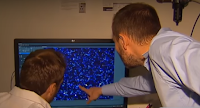
New 3D imaging technology is uncovering Alzheimer’s hard-to-solve secrets. See how sheets of light are shedding light on curing Alzheimer’s.


Rockefeller University researchers have used a recently-developed imaging technique that makes tissue transparent to visualize brain tissue from deceased patients with Alzheimer’s disease, exposing nonrandom, higher-order structures of beta amyloid plaques – sticky clumps of a toxic protein typically found in the brains of people with Alzheimer’s. The findings appear in Cell Reports.

Continued below video…

“Until now, we’ve been studying the brain using 2D slices; and I’ve always felt that was inadequate, because it’s a complex, 3D structure with many interlocking components,” says senior author Marc Flajolet, an assistant professor in the Laboratory of Molecular and Cellular Neuroscience at The Rockefeller University. “Not only was slicing time consuming and 3D reconstruction laborious when not erroneous, it gave us a limited view. We needed some way to look at this 3D structure in all of its dimensions without preliminary slicing of the brain.”

The researchers wanted to go beyond the traditional 3D brain imaging (e.g., PET or fMRI scans), which show brain activity in a broad way, but have a low resolution overall. To circumvent this, the research team turned to a recently-developed method, called “iDISCO.” Here, brains are soaked in a solution that imbue the fats within it with a charge, before being exposed to an electrical field with an opposite charge, which behaves like a magnet, forcing all of the fat out of the brain tissue.

The result, says Flajolet, is a brain that is hard and transparent, almost “like glass,” which allowed the researchers to see the amyloid plaques in full detail and in 3D, in a full mouse brain hemisphere, as well as in small blocks of human brain tissue.

“In mouse models, plaques are rather small, homogenous in size and shape, and not grouped in any specific way,” says Flajolet. “But in the human brain, we were seeing more heterogeneity, larger plaques and these new, complex patterns.” These structures, called TAPs (three dimensional amyloid patterns) may have implications for the future of Alzheimer’s disease treatment, he says. By comparing doctor’s reports of a patient’s symptoms with images of the patient’s brain post-mortem, they may be able to classify different categories of Alzheimer’s disease.

“There are people with brains full of plaques and no dementia at all”, he says, “and there are those with brains free of plaques with many of the symptoms.” In light of that, the way that current clinical trials view the disease–namely, that there is one category – might be incorrect, he says. It’s possible that current drugs may be beneficial only for a subset of Alzheimer patients, but we have no way to distinguish them at this day.

Flajolet stressed that, moving forward, we need a better understanding of these plaques, and Alzheimer’s hallmarks in general, as the relationship between their presence and the severity of the disease is not clear-cut. “Perhaps this will lead to the development of new and better targeted drugs, or allow us to rethink the drugs we have now – that’s what we hope for.”


REFERENCE:
Article: Three-Dimensional Study of Alzheimer’s Disease Hallmarks Using the iDISCO Clearing Method, Liebmann et al., Cell Reports, doi: 10.1016/j.celrep.2016.06.060, published online 14 July 2016.


MORE INFORMATION:

This work was supported, in part, by grants from the U.S. National Institutes of Health, the Fisher Center for Alzheimer’s Research Foundation, and the Cure Alzheimer’s Fund. Additional support was received from the Empire State Stem Cell Fund through the New York State Department of Health.

SOURCE:
Cell Press

Related:

Email me when people comment
Notify of
guest

0 Comments
Inline Feedbacks
View all comments
By:
Picture of Peter Berger

Peter Berger

With experience in dementia caregiving, public education, and Alzheimer’s-focused writing—and a professional research background shaped in what many consider one of the world’s top laboratories—I work to make complex findings clear, practical, and genuinely helpful for families and professionals providing care.

This site was inspired by my Mom’s autoimmune dementia.

It is a place where we separate out the wheat from the chafe, the important articles & videos from each week’s river of news. Google gets a new post on Alzheimer’s or dementia every 7 minutes. That can overwhelm anyone looking for help. This site filters out, focuses on and offers only the best information. it has helped hundreds of thousands of people since it debuted in 2007. Thanks to our many subscribers for your supportive feedback.

The site is dedicated to all those preserving the dignity of the community of people living with dementia.

Peter Berger, Editor

Share this page To

Dementia Books & Videos on Amazon:

More From Alzheimer's Weekly

Diagnosis

Lewy Body Dementia: Is It PDD or DLB?

LEWY BODY DEMENTIA is the second most common dementia as well as dementia’s most misdiagnosed type. Yet diagnosing it correctly is crucial for proper treatment. Learn about the 2 types of LBD, as well as types of dementia for which doctors mistake it.

Read More »
L-ARGININE PILLS: Arginine 1000 mg 120 Tablets - Pharmaceutical Grade
Prevention

Arginine on the Frontline: New Hope for Alzheimer’s

A new study suggests a simple nutrient — arginine — may reduce amyloid-β buildup in Alzheimer’s. The findings, from animal studies, raise an encouraging question: could arginine eventually play a role in Alzheimer’s prevention? Here’s what the research shows — and what caregivers should know.

Read More »
Man and Woman Lying on Bed with Eye Mask
Exercise

Sleeping and Loafing in Fighting Dementia

VIDEO & ARTICLE – ALZHEIMER’S INTERNATIONAL CONFERENCE:
In a set of 3 studies, see how exercise and sleep lowered Alzheimer’s, while sitting around and watching TV resulted in significantly worse brain health.

Read More »
Share to Facebook
Twitter
LinkedIn

Visit Alzheimer's Weekly On

Welcome

Alzheimer’s & Dementia Weekly was inspired by my mother’s journey with autoimmune dementia and my dad’s with Parkinson’s dementia.

Walking beside them opened my eyes to the confusion, the courage, and the deep humanity found in families and professionals caring for someone they love.

Since its debut in 2007, this site has had one clear mission:
to separate the wheat from the chaff — to highlight only the most essential articles, studies, tools, and videos from the overwhelming river of dementia-related information.
(At last count, Google receives a new post on Alzheimer’s or dementia every seven minutes.) For anyone seeking clarity or support, that constant flow can be exhausting and discouraging.

Alzheimer’s Weekly filters, translates, and explains what matters most, helping hundreds of thousands of families, clinicians, and care teams around the world make sense of the latest research and best practices.

This site is dedicated to everyone who works—often quietly and tirelessly—to preserve dignity in the community of people living with dementia.


About the Editor

With experience in dementia caregiving, public education, and Alzheimer’s-focused writing—and a professional research background shaped in what many consider one of the world’s top laboratories—I work to make complex findings clear, practical, and genuinely helpful for both families and professionals providing care.

My goal is simple:
Translate the best science into guidance that lightens the load, strengthens understanding, and helps every person with dementia live with dignity.

Peter Berger
Editor, Alzheimer’s Weekly

Free:
Alzheimer's & Dementia
Weekly Newsletter

INCLUDES BONUS BOOKLET:
15 Simple Things You Can Do to Care For a Loved One with Dementia or Memory Loss
News, Treatments, Care Tips, Diet, Research, Diagnosis, Therapies & Prevention
News to Get at the Truth

Subscribe To Our Weekly Newsletter

0
Would love your thoughts, please comment.x
()
x