Share This Page

Alzheimer’s Charities: Increase Donations with Free Personalized Newsletters

news, newsletter, boy on megaphone
Learn how a personalized Alzheimer's Weekly Newsletter can boost donations in your not-for-profit dementia organization. (Video+Article)

Boost donations effortlessly with free, personalized newsletters! These powerful tools build trust and engage supporters at the perfect moment—right when they’re ready to give.

Alzheimer’s and Dementia Weekly offers two tailored newsletter packages to fit your needs:
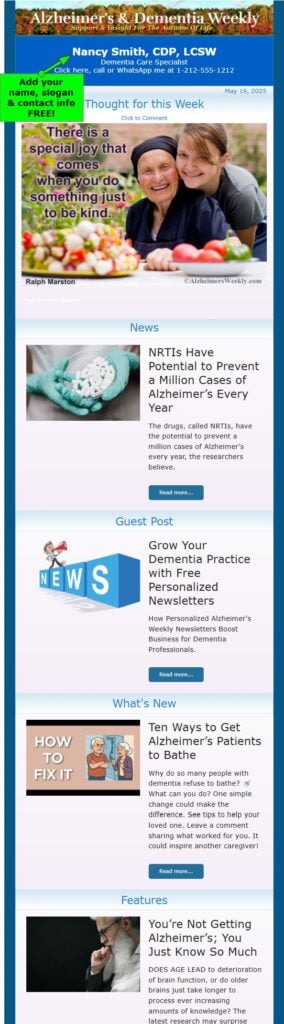
Alzheimer's Weekly Newsletter
  1. BASIC NEWSLETTER SERVICE – No cost. Your name, slogan, and contact details prominently displayed on each week’s newsletter. Simply forward it to your donors at no charge.   See for yourself the power of having your own personalized newsletter.
  2. FULLY-AUTOMATED NEWSLETTER – Set it up once, and let us handle the rest! Each week, your personalized and customized newsletter is automatically emailed to subscribers. Our system efficiently manages unsubscribes, new subscribers, spam filters, and subscription adjustments—starting at just $15 per month.

Stay connected, build loyalty, and maximize donations with ease!

For any of these services or more information, simply Contact Us or use the comment section below.
Why Charities Really Need a Newsletter

Not-For-Profit charities play a crucial role in guiding families through the complexities of Alzheimer’s care. That’s why charities depend on family engagement and building trust. They depend on patients and their loved ones keeping the charity and its services top-of-mind. A powerful way to achieve this is through a customized Alzheimer’s Weekly Newsletter, featuring the charity’s name, contact, and donation details prominently at the top.

This personalization does more than just remind supporters of their expertise—it transforms the newsletter into a valuable fundraising tool that directly increases contributions and commitment to your charity.

1. Personalized Branding Builds Instant Recognition

When a subscriber receives a weekly newsletter with their trusted Not-For-Profit’s name and phone number prominently displayed at the top, it reinforces familiarity. The more supporter see the charity’s name, the more likely they are to view them as their go-to foundation in dementia care. This consistent branding helps establish credibility and ensures supporters remember who to call when they need the charity’s services and when they want to make a contribution.

2. Increased Contribution & Engagement

Families dealing with dementia often need ongoing support but may hesitate to reach out without a clear next step. A personalized newsletter serves as a gentle yet effective reminder that help is available. When recipients see their Not-For-Profit’s contact information at the top of every newsletter, they feel encouraged to reach out, seek advice or support, or refer their friends and associates to their favorite charity.

3. Strengthening Trust Through Valuable Content

A well-crafted newsletter provides expert insights, caregiving tips, and the latest research—all while keeping the charity’s name and image at the forefront. This positions the charity as a trusted authority and reassures potential donors that they are receiving information from someone who truly understands dementia care.

Supporters who receive helpful, relevant advice each week are more likely to trust the charity’s reputation and feel confident in using their services and donating to the cause.

4. Expanding Referrals & Word-of-Mouth Growth

When a newsletter is personalized with a specific charity’s details, it becomes easier for clients to share it with friends, caregivers, or senior care professionals. This creates a ripple effect, expanding the chairty’s reach and generating valuable referrals from those already engaged with the content.

5. Turning Passive Readers into Donors

Many families subscribe to Alzheimer’s resources but don’t always take immediate action. By seeing their charity’s phone number or online donation link in every newsletter, clients are subtly reminded that help is just a call away and that making a contribution right now is easy. Over time, this consistent exposure transforms passive readers into contributing supporters who recognize the charity’s value and actively seek to help and support it.

Conclusion

A personalized Alzheimer’s Weekly Newsletter does more than just educate—it builds lasting trust, engagement, and supporter growth for Not-For-Profit Dementia Charities. By featuring the Dementia charity’s name, company, and phone number at the top, charities reinforce their offerings and their expertise, build relationships, and create a reliable pipeline of donors who turn to them when dementia-related challenges arise.

For any of these services or more information, simply Contact Us or use the comment section below.

Related:

Email me when people comment
Notify of
guest

0 Comments
Inline Feedbacks
View all comments
By:
Picture of Peter Berger

Peter Berger

With experience in dementia caregiving, public education, and Alzheimer’s-focused writing—and a professional research background shaped in what many consider one of the world’s top laboratories—I work to make complex findings clear, practical, and genuinely helpful for families and professionals providing care.

This site was inspired by my Mom’s autoimmune dementia.

It is a place where we separate out the wheat from the chafe, the important articles & videos from each week’s river of news. Google gets a new post on Alzheimer’s or dementia every 7 minutes. That can overwhelm anyone looking for help. This site filters out, focuses on and offers only the best information. it has helped hundreds of thousands of people since it debuted in 2007. Thanks to our many subscribers for your supportive feedback.

The site is dedicated to all those preserving the dignity of the community of people living with dementia.

Peter Berger, Editor

Share this page To

Dementia Books & Videos on Amazon:

More From Alzheimer's Weekly

Julianne Moore realizing she may have Alzheimer's in "Still Alice"
Music/Movies

Julianne Moore: Person of the Week

Actress Julianne Moore talks about the dignity of women with Alzheimer’s, as her movie enables the public to see “first-hand” what it’s like to have early-onset Alzheimer’s. Watch.

Read More »
Activities

Alzheimer’s, Art & Medical Students

Medical students often learn the technical facts of Alzheimer’s without learning about the people. Find out how a new program helps medical students better understand people with dementia — at the art museum.

Read More »
Inspiration

Who is Rudi Tanzi?

Harvard’s Dr. Rudolph Tanzi is edging Alzheimer’s research forward with a string of breakthroughs. He’s one of today’s most talked-about Alzheimer’s researchers. Watch Rudy Tanzi talk about the inspiration for his life’s work.

Read More »
Jackie and Kimberly at the Alzheimer's Center
Activities

1950s Diner Helps Alzheimer’s

VIDEO – INSIDE EDITION: A Californian “time capsule” kindles sparks of joy in Alzheimer’s, as people see a world they remember. A ’50s-themed diner has a jukebox playing rock ‘n’ roll classics and a 1959 Ford Thunderbird’s on display. Phone booths with rotary dials, vinyl record players and vintage clothing round things out. See Jackie and her daughter Kimberly playing music to jog mom’s memory and make new moments possible.

Read More »
Share to Facebook
Twitter
LinkedIn

Visit Alzheimer's Weekly On

Welcome

Alzheimer’s & Dementia Weekly was inspired by my mother’s journey with autoimmune dementia and my dad’s with Parkinson’s dementia.

Walking beside them opened my eyes to the confusion, the courage, and the deep humanity found in families and professionals caring for someone they love.

Since its debut in 2007, this site has had one clear mission:
to separate the wheat from the chaff — to highlight only the most essential articles, studies, tools, and videos from the overwhelming river of dementia-related information.
(At last count, Google receives a new post on Alzheimer’s or dementia every seven minutes.) For anyone seeking clarity or support, that constant flow can be exhausting and discouraging.

Alzheimer’s Weekly filters, translates, and explains what matters most, helping hundreds of thousands of families, clinicians, and care teams around the world make sense of the latest research and best practices.

This site is dedicated to everyone who works—often quietly and tirelessly—to preserve dignity in the community of people living with dementia.


About the Editor

With experience in dementia caregiving, public education, and Alzheimer’s-focused writing—and a professional research background shaped in what many consider one of the world’s top laboratories—I work to make complex findings clear, practical, and genuinely helpful for both families and professionals providing care.

My goal is simple:
Translate the best science into guidance that lightens the load, strengthens understanding, and helps every person with dementia live with dignity.

Peter Berger
Editor, Alzheimer’s Weekly

Free:
Alzheimer's & Dementia
Weekly Newsletter

INCLUDES BONUS BOOKLET:
15 Simple Things You Can Do to Care For a Loved One with Dementia or Memory Loss
News, Treatments, Care Tips, Diet, Research, Diagnosis, Therapies & Prevention
News to Get at the Truth

Subscribe To Our Weekly Newsletter

0
Would love your thoughts, please comment.x
()
x