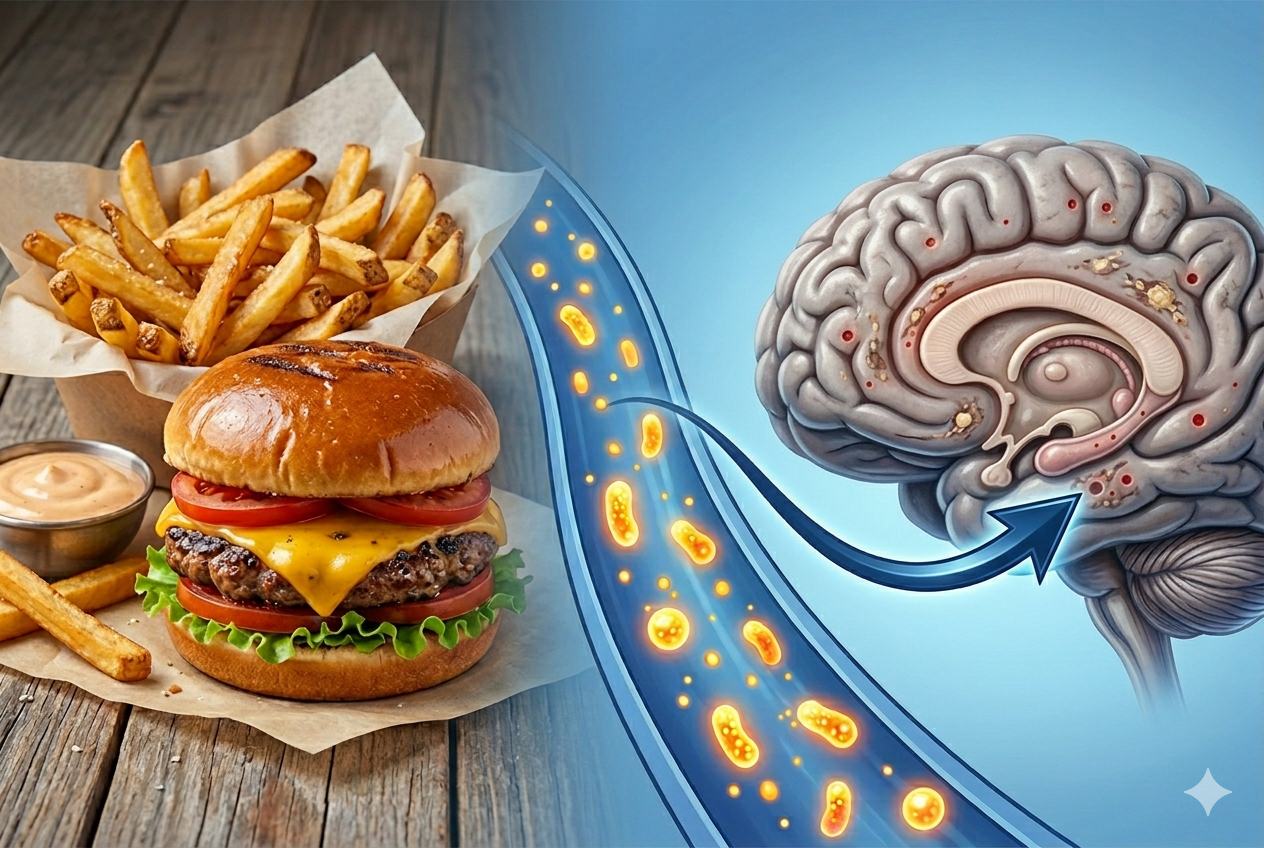
Within hours of a fatty meal, levels of certain bacterial toxins can spike in the bloodstream.
Researchers have also detected these same toxins embedded inside Alzheimer’s plaques.
Could these two findings be connected—or is this just a coincidence?
What Are Endotoxins—and Why Do They Rise After Fatty Meals?
Endotoxins are components of the outer membrane of certain bacteria—especially those living in the gut. When these bacteria break down, they release substances known as lipopolysaccharides (LPS), often referred to simply as endotoxins.
Under normal conditions, only small amounts enter the bloodstream. But after a high-fat meal, studies suggest that more of these endotoxins can pass from the gut into circulation—a process sometimes called metabolic endotoxemia.
Why does this happen?
- Fat may help transport endotoxins across the gut barrier
- Certain meals may temporarily increase gut permeability
- Endotoxins can “hitch a ride” on fat particles (lipoproteins) in the blood
The result: a measurable rise in circulating endotoxins after eating fatty foods.
What Happens in the Hours After a Fatty Meal
Why This Matters: Inflammation and the Brain
Endotoxins are not just passive bystanders. They are known to trigger immune responses and inflammation in the body.
Chronic, low-grade inflammation has long been linked to Alzheimer’s disease. Researchers have been exploring whether repeated exposure to endotoxins could contribute to this inflammatory environment over time.
For caregivers and families, this matters because it suggests that everyday metabolic processes—like what happens after a meal—may influence brain health in subtle ways.
The Surprising Finding Inside Alzheimer’s Plaques
Perhaps the most intriguing discovery is this: researchers have found endotoxins within amyloid plaques themselves—one of the defining hallmarks of Alzheimer’s disease.
Amyloid plaques are clusters of misfolded protein that accumulate in the brain. They have traditionally been viewed as a central feature of the disease process.
Finding endotoxins inside these plaques raises several important questions:
- Are endotoxins contributing to plaque formation?
- Are plaques forming as a defensive response to these toxins?
- Or are endotoxins simply getting trapped in plaques after the fact?
At this stage, researchers do not have definitive answers. But the overlap is difficult to ignore.
A New Way to Think About Plaque?
One emerging idea is that amyloid plaques may not be purely harmful. Some scientists have proposed that amyloid could act as part of the brain’s innate immune system, helping to trap or neutralize invading microbes or toxins.
If that’s the case, the presence of endotoxins in plaques might reflect the brain responding to perceived threats—not just malfunctioning.
This perspective doesn’t overturn existing theories, but it adds a new layer:
- Alzheimer’s may involve not only protein misfolding
- But also immune activity, inflammation, and environmental triggers
What This Does—and Does Not Mean
It’s important to stay grounded in what the science actually shows.
What we know:
- Endotoxins can rise after high-fat meals
- Endotoxins can trigger inflammation
- Endotoxins have been found in Alzheimer’s plaques
What we do not know:
- Whether endotoxins directly cause plaques
- Whether dietary fat meaningfully accelerates Alzheimer’s
- Whether reducing endotoxin exposure changes disease outcomes
In other words, this is a promising but early-stage line of research.
Practical Takeaways for Caregivers
While the science is still evolving, there are a few practical, low-risk insights worth considering:
- Diet patterns that reduce inflammation may support overall brain health
- Meals rich in whole foods (vegetables, fiber, healthy fats) may help maintain gut integrity
- Avoiding repeated spikes in metabolic stress could be beneficial over time
Importantly, this is not about eliminating fat altogether. Rather, it’s about quality, balance, and consistency.
For caregivers, the goal is not perfection—it’s supporting long-term health in manageable ways.
The Bottom Line
The idea that something as routine as a fatty meal could influence biological processes linked to Alzheimer’s is both surprising and thought-provoking.
We are not yet at the point of clear cause-and-effect. But the connection between diet, gut biology, inflammation, and brain health is becoming harder to dismiss.
As research continues, one thing is increasingly clear:
Alzheimer’s is not just a brain disease—it may also reflect what’s happening throughout the body.