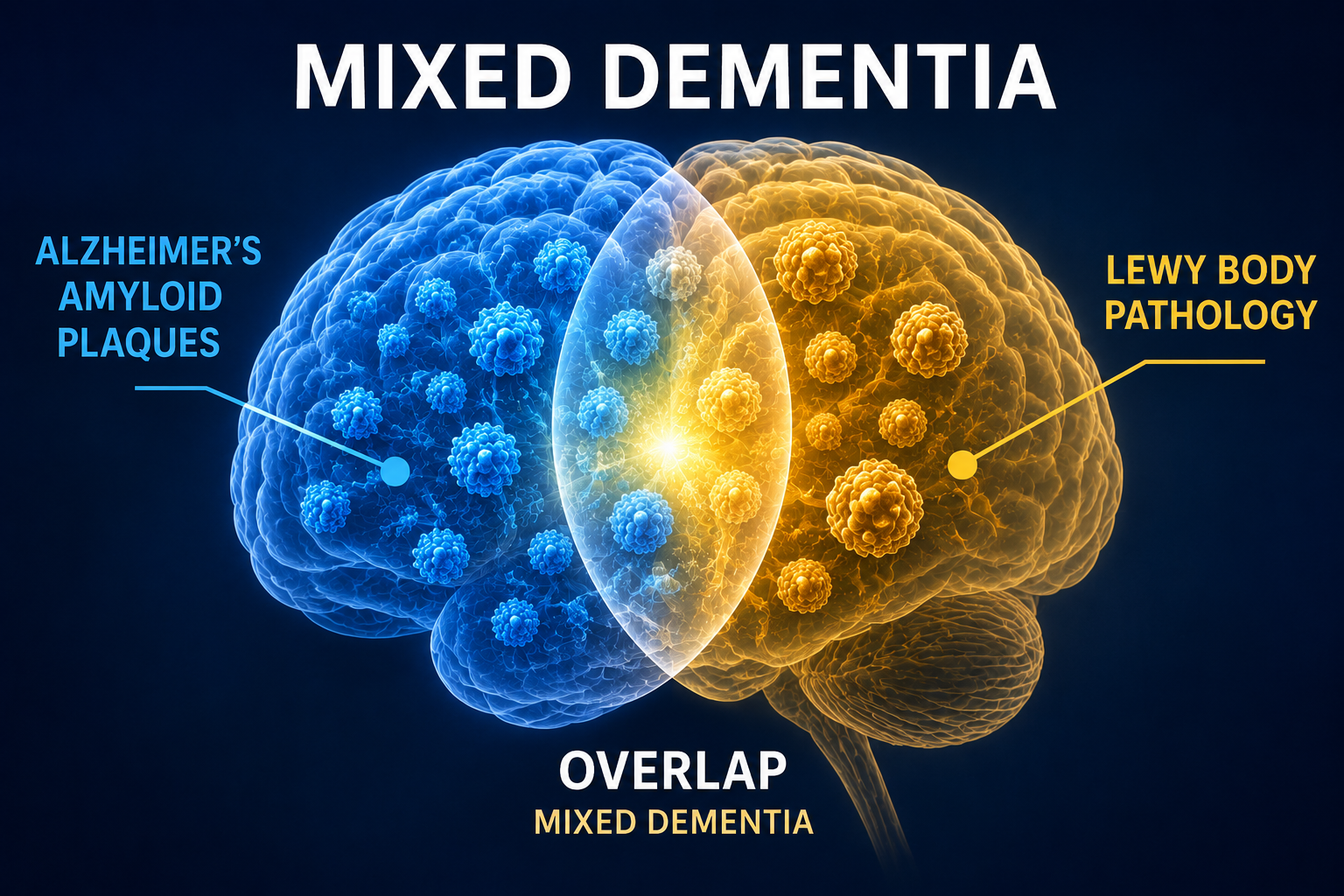
More than half of people with dementia who were studied at Alzheimer’s Disease Research Centers had evidence of more than one cause of dementia, known as Mixed-Dementia, according to the Alzheimer’s Association.
That fact surprises many families. Most people think of dementia as a single condition, such as Alzheimer’s, Lewy body dementia, or vascular dementia. In reality, researchers increasingly recognize that multiple disease processes often occur together.
This concept, known as mixed dementia, may help explain why symptoms can sometimes seem confusing or inconsistent.
Now, a new clinical trial is testing whether Lilly’s Alzheimer’s drug Kisunla can help people with both Lewy body dementia and Alzheimer’s. If successful, the implications could extend far beyond Lewy body dementia.
Mixed Dementia May Be More Common Than Many People Realize
Researchers have known for years that different brain diseases can occur together.
For example, a person may have:
- Alzheimer’s and Lewy body dementia
- Alzheimer’s and vascular dementia
- Alzheimer’s and other age-related brain changes
Autopsy studies suggest that more than half of people with dementia have evidence of multiple brain diseases contributing to their symptoms.
This overlap can make diagnosis challenging. A person may experience memory loss typical of Alzheimer’s while also developing hallucinations, movement problems, sleep disturbances, or changes in attention more commonly associated with Lewy body dementia.
For caregivers, mixed dementia may explain why a loved one’s symptoms do not always fit neatly into a single category.
Why Researchers Are Testing Kisunla
Kisunla (donanemab) is an FDA-approved treatment for people with early Alzheimer’s.
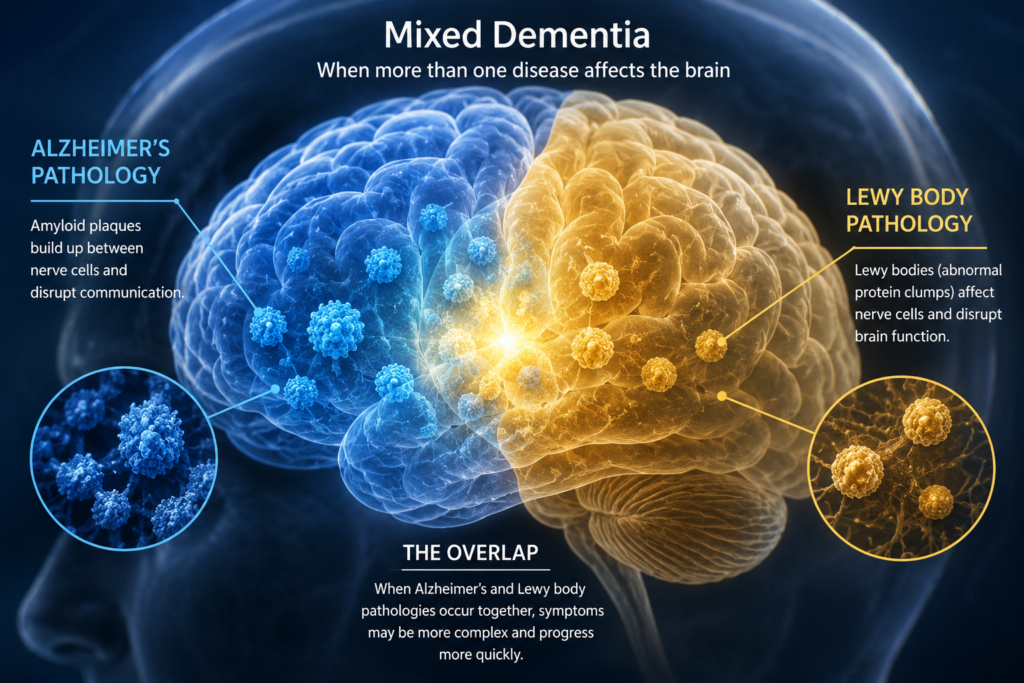
The drug works by removing amyloid plaques from the brain. Amyloid is one of the hallmark biological changes associated with Alzheimer’s.
Clinical trials showed that Kisunla can slow cognitive and functional decline in people with early Alzheimer’s who have confirmed amyloid buildup.
That success has led researchers to ask a new question.
If Alzheimer’s pathology is only one part of a person’s dementia, could treating that part still provide meaningful benefit?
Why Start With Lewy Body Dementia?
The new study focuses on people who have both Lewy body dementia and evidence of Alzheimer’s-related amyloid plaques.
Researchers chose this group because the overlap is surprisingly common.
Studies suggest that between 50% and 80% of people with dementia with Lewy bodies also have significant Alzheimer’s pathology. Researchers have also found that people with both conditions often experience faster decline than those with either condition alone.
That raises an important possibility.
If amyloid contributes to the progression of symptoms, removing it could potentially help even when Lewy body disease remains present.
The Bigger Question Behind the Trial
Although the study focuses on Lewy body dementia, its importance may reach much further.
The trial is not really testing whether Kisunla treats Lewy body dementia itself.
Instead, researchers are asking whether treating the Alzheimer’s component of a mixed dementia can improve outcomes.
If the answer is yes, similar approaches could eventually be explored in other forms of mixed dementia, including combinations involving vascular disease and other age-related brain disorders.
That would represent an important shift in dementia care.
Rather than focusing only on a diagnostic label, treatment could increasingly target the specific disease processes occurring within an individual’s brain.
Reasons for Hope—and Caution
The scientific rationale for the study is strong.
Kisunla removes amyloid plaques. It has already shown benefit in Alzheimer’s. Many people with Lewy body dementia also have significant amyloid pathology.
However, researchers do not yet know whether removing amyloid will provide meaningful clinical benefits when another disease process is also contributing to decline.
That is precisely what the new study is designed to determine.
The trial is expected to run through 2028.
What This Means for Caregivers
The study will not change treatment recommendations today.
But it highlights an important reality that many families may not realize: dementia is often caused by more than one disease process.
Understanding that fact can help explain why symptoms sometimes appear mixed, why diagnoses can evolve over time, and why researchers are beginning to look beyond traditional categories.
For years, dementia research has largely focused on treating one disease at a time.
This new Kisunla trial is asking whether treating one important piece of the puzzle can help people whose dementia is more complex.
For millions of families living with mixed dementia, that is a question worth answering.